A backup dashboard answers whether a job completed under its configured checks. The question an application owner usually cares about is different: can the service be recovered, with acceptable data loss, within the time the business can tolerate?
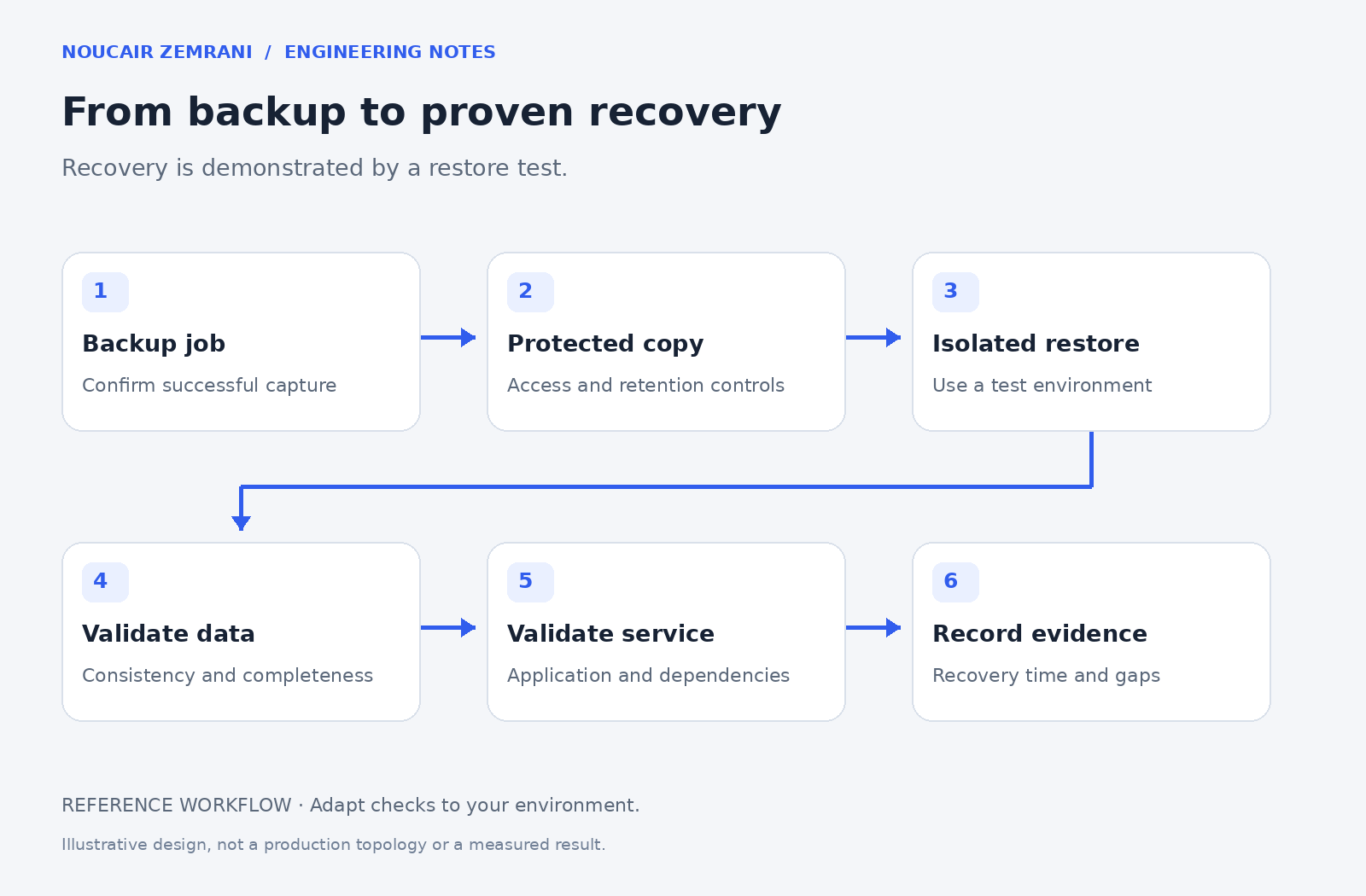
My operations experience includes NetBackup and IBM Spectrum Protect. The checklist here is a general recovery-testing approach; it does not claim a recovery-time result for a particular environment.
Define what must be recovered
Start with a service and its dependencies. Identify application files, databases, configuration, certificates, identity dependencies, and access to the backup platform itself. Keep secrets in the approved secure system, with a documented access process that remains usable during an incident.
Agree on recovery point and recovery time objectives with the service owner. Those are requirements to test against, not performance numbers to invent after a successful job. A restore that meets the infrastructure team’s expectations may still fail the application owner’s needs.
Restore into an isolated environment
Avoid connecting a restored copy to production integrations by default. A recovered application could send real emails, process scheduled jobs, or accept conflicting writes. Establish isolation, test credentials, and a controlled validation plan before starting the copy.
Choose a representative recovery point and document why it was chosen. A useful test checks that the retained backup can actually be accessed and used, rather than testing only the most convenient recent copy every time.
Verify the service, not only the files
Confirm that the application starts, its dependencies are available, and representative data is consistent. Ask the application owner to validate a useful transaction or report. Record the recovery point used, prerequisites, elapsed times, unexpected work, and unresolved issues.
If a restore requires an undocumented configuration change, add it to the runbook. If the chosen backup lacks a dependency, record the gap and its owner. The purpose of a rehearsal is to uncover these problems while the production service is still available.
Make retesting part of operations
Repeat tests after material application or infrastructure changes and at an agreed frequency. Review retention, access controls, separation from the primary environment, and protection against destructive changes. There is no universal frequency that fits every service.
The outcome should be a recovery record that another engineer can follow and a short action list for the gaps. If your team has backup success reports but little restore evidence, I can help define a scoped recovery rehearsal and handover.