If deploying an application requires remembering five commands, the team has a process that lives partly in someone’s head. The immediate cost is usually interruption: one person becomes the release dependency. The larger cost appears when that person is unavailable and nobody knows which image, configuration, or recovery procedure was used.
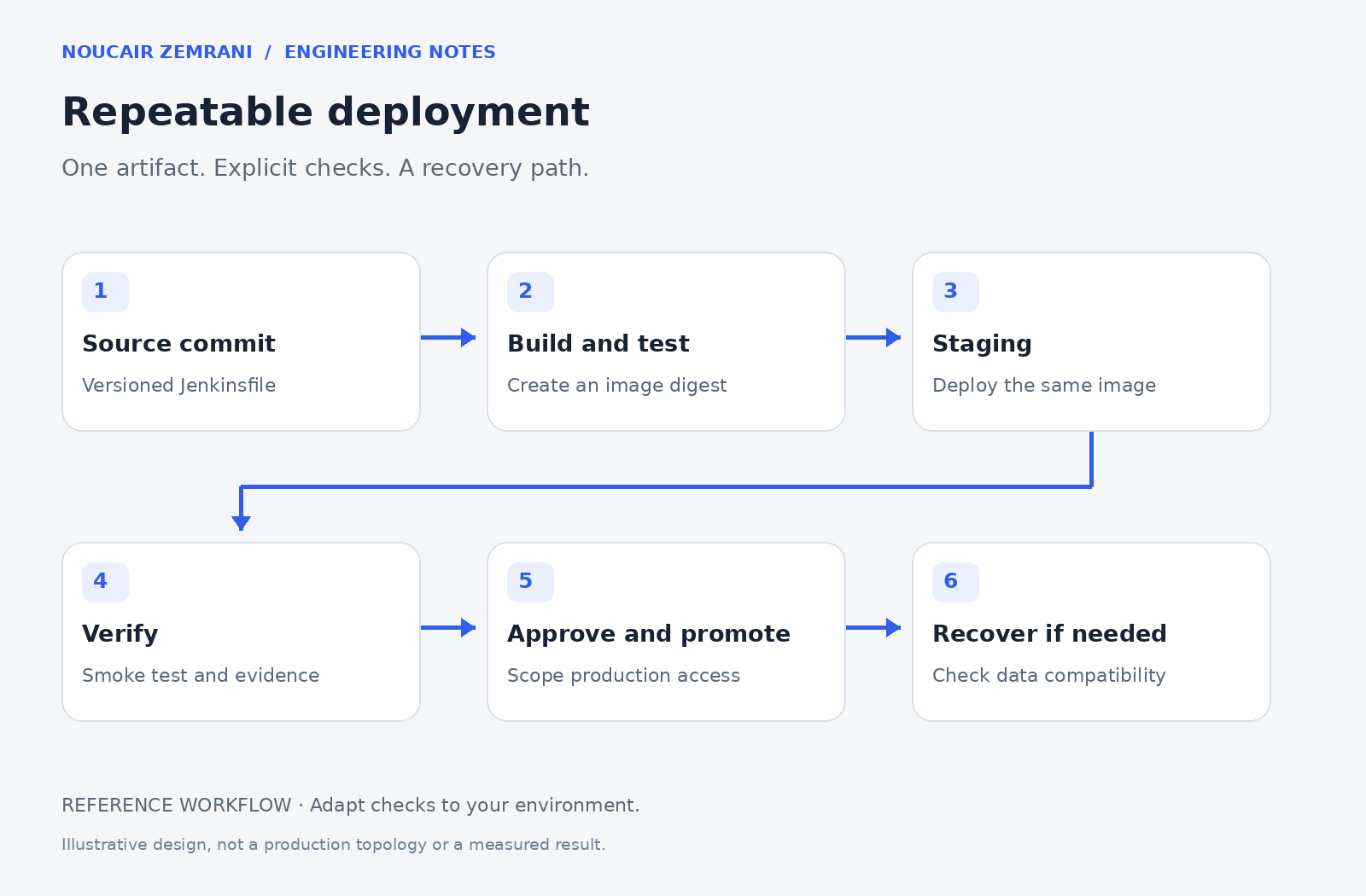
Start with the release contract
Before automating commands, write down what a successful release means. Identify the application, target environment, required configuration, persistent data, and verification steps. Decide who can approve a production change and who owns recovery. A pipeline that automates an unclear process makes mistakes repeatable too.
For a small service, a useful release contract might be: build the selected commit, run tests, create one identifiable container image, deploy that exact image to staging, verify it, and promote it only after approval. Production should not silently rebuild different software from the same label.
Put the workflow beside the code
Jenkins supports defining a pipeline in a version-controlled Jenkinsfile. This gives the team a reviewable history of delivery changes. Keep environment-specific secrets in an appropriate credential store rather than in the repository. Restrict deployment credentials to the environment and operations they need.
Docker packages the application, but the release also depends on configuration, networks, volumes, and external services. Record those dependencies. An immutable image digest is stronger release evidence than a mutable tag such as latest.
Treat verification as part of deployment
A deployment is not complete because the remote command returned zero. Check that the expected version is running and that a representative application operation works. Give checks a clear timeout. Record what was deployed, where, by whom, and which checks passed.
Write the recovery procedure before the release. Reverting an image can help with application code, but it does not automatically reverse a database migration. Identify compatibility constraints, backups, and any operation that requires manual intervention.
A checklist to use with your next release
- Can another engineer identify the exact source commit and image?
- Are configuration and secrets managed separately?
- Are deployment permissions scoped?
- Does verification test useful application behavior?
- Is there an explicit recovery decision and owner?
- Can the team find the release record afterward?
My practical starting point
My public Jenkins and Docker engineering lab illustrates delivery automation. It is a lab, not evidence of a client’s production results. The useful discussion is how to adapt the same discipline to your application and operating constraints.
If your team wants to make one deployment repeatable, send me the current steps and acceptance criteria. We can define a focused implementation and handover.